

Your Trusted Ally in Immigration Matters in Ecuador
Meet lawyer Priscila Yasbek Your Trusted Legal Expert
Professional Experience
With 20 years of experience in immigration law and other related areas. Lawyer Priscila Yasbek has successfully guided hundreds of clients through the complex visa process with outstanding results.
Personalized Legal Assistance
Priscila Yasbek, an experienced immigration lawyer, provides strategic legal advice customized to your situation, helping you achieve successful and stress-free visa results.
Expertise You Counts
Lorem ipsum dolor sit amet conse adipiscing elit tellus.
Dedicated Support
Lorem ipsum dolor sit amet conse adipiscing elit tellus.
Layer Priscila Yasbek is a highly experienced immigration lawyer dedicated to helping individuals navigate Ecuador’s visa system with ease and confidence. Known for her professionalism and personal approach, she is committed to delivering exceptional legal services while making sure every client feels understood and supported throughout the entire process. Whether you are applying for a temporary visa, permanent residency, or any other immigration-related matter, you can rely on Dr. Yasbek’s expertise to guide you every step of the way.


Expert legal guidance for your visa journey

Expert support for immigration success
Ecuador immigration options
Assisting Clients from All Over The World in Successfully Navigating Ecuadorian Immigration
01. Temporary Visa
02. Exception Temporary Visa
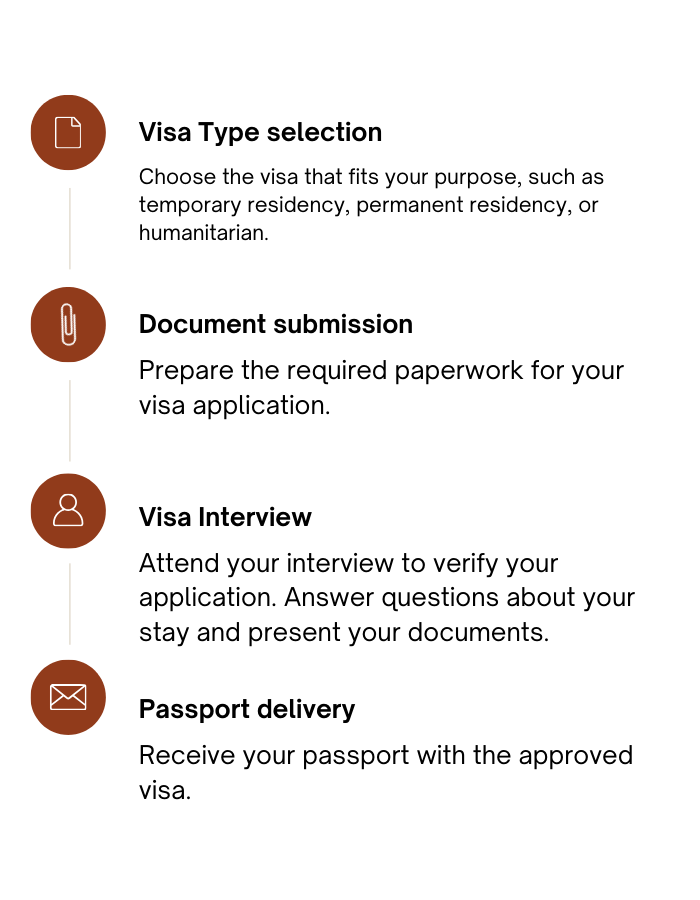
Ecuador Visa Application Process
We provide comprehensive legal assistance throughout the entire Ecuador visa application process, ensuring that each step is handled efficiently and with the utmost attention to detail. From initial consultation to final approval, we are here to support you every step of the way.
Sed ut perspiciatis unde omnis iste natus error sit voluptatem accusantium doloremque.
Sed ut perspiciatis unde omnis iste natus error sit voluptatem accusantium doloremque.
Sed ut perspiciatis unde omnis iste natus error sit voluptatem accusantium doloremque.
Sed ut perspiciatis unde omnis iste natus error sit voluptatem accusantium doloremque.
Sed ut perspiciatis unde omnis iste natus error sit voluptatem accusantium doloremque.
Sed ut perspiciatis unde omnis iste natus error sit voluptatem accusantium doloremque.
Sed ut perspiciatis unde omnis iste natus error sit voluptatem accusantium doloremque.

Expert guidance and qualified help
We provide tailored visa services that prioritize your needs, ensuring a smooth and secure process. Trust us to handle your immigration journey with precision and care.
• Expertise You Can Rely On: Showcase the team’s experience and success rate.
• Tailored to Your Needs: Emphasize individual attention for unique cases.
• Efficiency and Security: Guarantee swift approvals and secure handling of sensitive information

Trusted Legal Advisors for Foreign Residents






Share your email for updates on the Ecuador visa process
Frequently Asked Question
A person who passes through Ecuador as a passenger in transit, crew member of international transport, temporary migrant worker, or someone residing in the border zone according to international agreements and other legal regulations.
The tourist status is for the purpose of tourism activities only, and working is prohibited. To work, the appropriate visa must be obtained, whether within the initial 90 days or its extension after entering Ecuador.
i) 90 days within a one-year period from the first entry; can be extended for another 90 continuous days with a request and payment to the relevant authority.
ii) 180 days if the tourist is from South America, within a one-year period from their first entry.
The visa is valid for up to 180 days and can be granted once per calendar year, starting from the issuance date. It is intended for foreigners who will perform commercial activities, establish business contacts, carry out administrative or judicial procedures, or engage in sports, volunteer work, studies, or activities related to science, technology, innovation, arts, and culture.
ii) 180 days if the tourist is from South America, within a one-year period from their first entry.
Foreign nationals who request to be recognized by the Ecuadorian state as asylum seekers, refugees, or stateless persons.
ii) 180 days if the tourist is from South America, within a one-year period from their first entry.
Humanitarian reasons may include:
- Victim of a natural or environmental disaster
- Victim of human trafficking
- Victim of migrant trafficking
- Other reasons determined by the mobility authority (according to the law and regulations)
ii) 180 days if the tourist is from South America, within a one-year period from their first entry.
They are:
- TEMPORARY RESIDENT VISA (which is different from a temporary visitor visa) (this allows a stay for up to two years, renewable multiple times).
- PERMANENT RESIDENT VISA (indefinite stay, as long as legal conditions are met, such as not being absent for more than 180 days).
ii) 180 days if the tourist is from South America, within a one-year period from their first entry.
i. Work: For those entering or residing in Ecuador to engage in dependent employment in the public or private sector or as an independent professional, providing services to individuals or legal entities established in Ecuador.
ii. Renter: For those with personal income from abroad or other lawful external sources, or who have income from Ecuadorian sources.
iii. Retiree: For those receiving a pension from abroad sufficient to cover living expenses.
iv. Investor: For those with lawful assets and financial resources to carry out productive or commercial activities in Ecuador. This includes legal representatives, attorneys, commercial agents, or similar positions of national or foreign companies.
v. Scientist, Researcher, or Academic: For those engaged in scientific, research, or academic activities, contracted by public or private institutions, or participating in Ecuadorian educational programs.
vi. Athlete, Artist, or Cultural Manager: For those contracted to perform these activities by individuals or legal entities.
vii. Religious or Religious Volunteer: For those engaged in official religious activities, recognized by Ecuador.
viii. Volunteer-Missionary: For those offering voluntary services to the community with the support of a non-profit organization.
ix. Student: For those entering Ecuador for educational activities at recognized schools or universities. Student visas are valid for the duration of the academic program, and the visa cannot be less than six months.
x. Professional, Technician, Technologist, or Artisan: For those entering Ecuador to exercise their profession or technical activities according to the law.
xi. Government Cooperants, NGOs, and Foreign Press: For those part of a Cooperation Agreement between Ecuadorian public institutions and foreign institutions, as well as foreign media correspondents.
xii. Resident by Agreement: For those entering Ecuador under a visa defined by an international agreement to which Ecuador is a party.
xiii. Dependents of Migratory Category Holders: For children, spouses, or legally recognized domestic partners of the primary visa holder, with the same visa duration as the holder.
xiv. Persons Under International Protection: For individuals recognized by Ecuador as asylum seekers, refugees, or stateless, who do not meet the requirements for other migration categories.
xv. Maritime Crew: For those part of the crew on special, commercial, or industrial vessels.
By themselves, documents issued abroad are not valid for obtaining visas in Ecuador. For each case, the following formalities should be checked:
- They must be legible.
- They must be issued through a legal procedure and by a competent authority.
- They must have stamps, electronic and/or physical signatures certifying them.
- They must be translated by an official translator into Spanish, following a notarization process in Ecuador if the documents are in another language (e.g., English, German, Portuguese, Mandarin, etc.).
You cannot be absent for more than one hundred and eighty (180) days in each year, counted from the date of obtaining the immigration status, during the first two years.
- They must be legible.
- They must be issued through a legal procedure and by a competent authority.
- They must have stamps, electronic and/or physical signatures certifying them.
- They must be translated by an official translator into Spanish, following a notarization process in Ecuador if the documents are in another language (e.g., English, German, Portuguese, Mandarin, etc.).
This is the immigration status that authorizes indefinite stay in the national territory for those who meet at least one of the following conditions:
- Completing at least twenty-one continuous months of residence in Ecuador as a resident and submitting the corresponding application before the expiration of the current residence, as determined by Ecuadorian regulations.
- Having married or being in a legally recognized de facto union with an Ecuadorian or a foreigner with permanent residence.
- Being a foreign minor, child, or adolescent, or a person with a disability who depends on an Ecuadorian or a foreigner with permanent residence in Ecuador.
- Being a relative up to the second degree of consanguinity or affinity of an Ecuadorian citizen or a foreign citizen with permanent residence in Ecuador.
During the first two years, you cannot be absent for more than one hundred and eighty (180) days in each year, counted from the date of obtaining the immigration status. After this period, you may be absent for up to two continuous years. If this period is exceeded, you will lose your permanent residence.
During the first two years, you cannot be absent for more than one hundred and eighty (180) days in each year, counted from the date of obtaining the immigration status. After this period, you may be absent for up to two continuous years. If this period is exceeded, you will lose your permanent residence.
According to Ecuadorian regulations, there are fees to be paid for:
- The visa application (if rejected, for example, if you withdraw the application or fail to meet the observations issued by the immigration authority, the fee is lost).
- When the visa is approved and before its issuance, these fees may be reduced and vary depending on the visa type, the nationality of the foreign person, or the validity of agreements with Ecuador.
All these possibilities are possible as follows:
- The termination of the visa occurs when the time for which it was authorized has expired.
- The cancellation of the visa is an administrative act that occurs when the holder voluntarily requests it or when the reason for granting the visa no longer exists, allowing the application for a new immigration status. The cancellation can also happen automatically if:
- The facts that justified granting the immigration status have disappeared.
- The foreign person has obtained a new immigration status.
- The person repeatedly engages in acts unrelated to the granted migration category.
- A resident leaves the country twice, exceeding the authorized time limits established by this law.
- A permanent resident has been absent from the country for two consecutive years after the first two years of their visa.
Voluntary cancellation occurs when the foreign person has a valid visa and requests it at diplomatic missions or consular offices before its expiration.
Revocation of the visa is an administrative sanction that extinguishes the immigration status allowing the foreigner’s stay in the country and occurs when:
- The holder has been sentenced to a prison term longer than five years, according to current expulsion laws.
- The holder has obtained the immigration status fraudulently, duly proven, in which case they will be handed over to the competent judicial authority. According to international instruments ratified by Ecuador, victims of human trafficking or smuggling of migrants are exempt from this sanction.
- The holder has committed acts that threaten public safety or the structure of the State, as determined by the competent authority.
Ecuadorian nationality is obtained through the naturalization process, based on an administrative act issued by the competent mobility authority.
The people who can apply for naturalization are:
- Foreign persons with permanent residence visas who have been regularly domiciled in Ecuador for at least three years at the time of submitting the application.
- Persons recognized by the Ecuadorian State as refugees or stateless persons who have resided in the country for at least two years. Refugees and stateless persons may access an exceptional naturalization mechanism.
General requirements are as follows:
- Reside regularly and continuously in the country with a permanent residence visa in accordance with the regulations of the Organic Law of Human Mobility.
- Have a document duly apostilled or legalized, issued by the competent authority of the country of origin, indicating the place of birth and other personal data of the applicant, except for persons recognized by Ecuador as refugees or stateless.
- Be over 18 years of age at the time of application.
- For persons under 18, the consent of those holding parental authority or legal guardianship is required, and the opinions of minors and adolescents will be considered, according to the special Law on Children and Adolescents.
- Have general knowledge of Ecuador’s history, geography, culture, and current reality.
- Be able to speak and write in Spanish.
- Have lawful means of support in the country. In the case of foreign persons with disabilities who depend financially on a third party, the third party must demonstrate their financial capacity and lawful means of support in the country.
- Be up to date with obligations to the Ecuadorian State.
- Present an interview explaining the reasons for wanting to acquire Ecuadorian nationality.
Exemptions:
- Those who have completed a university degree or postgraduate studies in Ecuador, provided the program was taught in Spanish and in accordance with the current higher education regulations.
- Individuals over 65 years old at the time of submitting the application are exempt from the knowledge of Ecuadorian history, geography, and culture, but must still speak and write in Spanish.
- Children, adolescents, persons with intellectual disabilities, or those with disabilities that prevent them from fulfilling these requirements due to their condition.
In addition, depending on the reason for the naturalization application (e.g., marriage, adoption, children or adolescents born abroad to Ecuadorian parents, or persons who have provided relevant services to the country), specific requirements will apply.
- Submission of inaccurate documentation to the immigration control authority, according to the authority’s evaluation.
- Submission of destroyed documentation to the immigration control authority, according to the authority’s evaluation.
- Being recorded with a non-admission order due to prior deportation or inadmission under the grounds of this Law, while the ban on reentry remains in effect.
- Not having fulfilled the legally determined period to return to the country, as per the criminal law for expulsion cases.
- Lack of a valid and current travel document issued by the competent authority of the place of origin or residence, except for persons requesting international protection with an admission resolution duly notified in Ecuador by the competent authority.
- Lack of a valid visa when required according to Ecuador’s immigration policy or failure to justify immigration status.
- Being considered a threat or risk to public safety and the state’s structure, according to the information held by competent authorities.
- Attempting to intentionally evade immigration filters.
- Obstructing the work of the immigration control authority.
- Not possessing a vaccination card or certificate in accordance with what the national health authority determines.
- Being recorded for committing one or more immigration infractions, and not having paid the imposed monetary fine. Foreigners mentioned in Article 170, numeral 2 of this Law may enter by paying the fine, as long as they obtain a consular visa or have sufficient time available for their stay in accordance with this Law. Foreigners who fail to regularize their status within two years after their exit from Ecuador are exempt from paying the fine.
- Not having available days in their chronological year according to the immigration condition or category applied for.
- Not appearing for the deportation procedure after being legally notified and attempting to re-enter Ecuador.
- Evasion of exit immigration filters, unless the foreigner has a valid temporary or permanent residence visa, in which case a fine of 50% of the unified basic salary will apply. For repeat offenders, the fine will be equivalent to one full unified basic salary. The immigration control authority is responsible for determining these cases and initiating the inadmissibility procedure, while respecting constitutional due process rights. Inadmissibility processes will not be initiated against children or adolescents, who will be dealt with in accordance with Article 129 of this Law. Transportation companies that transport inadmissible persons will be responsible for immediately returning them to their country of origin or last embarkation point, or to the country that will receive them, and must remain at port until all passengers are cleared by immigration authorities. If this is not complied with, the transport company will face administrative sanctions. Inadmissibility causes do not apply to applicants for international protection, in which case the immigration control authority will immediately notify the migration authority to begin the corresponding process.
Yes, deportation exists. It is the administrative resolution by which the immigration control authority orders the foreigner’s departure from Ecuador, with a ban on re-entry for three years starting from their exit date. Deportation can only occur under the grounds specified in the Organic Law on Human Mobility and will adhere strictly to due process guarantees outlined in the Constitution of the Republic of Ecuador.
A foreigner may be deported from Ecuador for any of the following reasons:
- Entering through an unauthorized place, except for those under international protection.
- Providing fraudulent or altered documentation at any time and presenting it to any public authority, subject to criminal responsibility.
- Failing to begin the regularization process within the timeframe established by this Law.
- Repeatedly committing immigration infractions.
- Having their visa revoked and failing to leave the country within the required period.
- Failing to comply with the notification to leave the country within thirty days.
- Being considered a threat or risk to public safety and state structure, according to the information held by the competent authorities.
- Being sentenced for a crime punishable by more than five years in prison, according to current criminal law.
- Being sanctioned for committing offenses under criminal law that alter public order or peace.
- Being inadmissible to Ecuador under a resolution that has become final and failing to comply with precautionary measures set by the immigration authority or not presenting themselves for execution of the inadmissibility.
Immigration infractions and sanctions:
- A person who engages in activities outside the scope permitted by their visa or migratory status will be fined one unified basic salary. In case of recurrence, the migratory status will be canceled, and they will not be allowed to apply for a new status for two years.
- A person who does not change their migratory status within the period provided by this Law will be fined: a) If they don’t change their status, they will be fined 50% of one unified basic salary. b) If a foreigner entered as a tourist with a 90-day stay and overstayed without requesting an extension, or if they overstayed 180 days, they will be fined one unified basic salary. *Exceptions are made for those who have exceeded two years since their departure from Ecuador.
- A permanent resident who is absent for more than 180 days within the year from the date of obtaining their status will be fined 50% of one unified basic salary.
- A foreigner who entered into a simulated marriage or union solely for the purpose of obtaining migratory status will be fined five unified basic salaries, without prejudice to actions against the Ecuadorian national involved.
- A person who facilitates or allows a foreigner to evade immigration control will be fined three unified basic salaries.
- Transportation companies that embark or disembark foreigners at non-designated locations will be fined 15 unified basic salaries.
- Companies that transport foreigners to Ecuador without valid immigration documentation will be fined 15 unified basic salaries.
- Companies that operate international transportation but fail to provide the necessary traveler and crew information will be fined 15 unified basic salaries.
- Transport companies that do not stay in port until immigration checks all arrivals and confirms the existence or non-existence of inadmissible persons will be fined 15 unified basic salaries.

